
















A judge of the International Criminal Court yesterday issued a defiant message to its superpower critics in the wake of the trilateral summit in Beijing.
Judge Kimberly Prost, a Canadian, told journalists at the ICC’s HQ in The Hague that the court ‘will not be intimidated’ as the US seeks to ‘tear down’ the institution.
Prost also gave a candid account to the Gazette of how the sanctions are affecting judges personally. The UK government took no action when Prost had assets frozen here, and on a recent visit to London she was even blocked as an ‘undesirable person’ from using Google Maps.
The ICC is facing an existential crisis after the US last month extended an existing sanctions package on individual ICC officials to the entity as a whole. Asset freezes were imposed on any property owned by the court and all transactions by US individuals or entities involving the ICC were prohibited.
The pressure was ramped up again yesterday as Donald Trump, Vladimir Putin and Xi Jinping took aim at the ICC at their unprecedented meeting in China. The trio reasserted the importance of immunity for state officials, and said that the ICC and other similar bodies must not abuse their jurisdiction.
Trump said the ICC, which has an arrest warrant out for his 'friend' Putin for alleged war crimes, was 'out of control', condemning what he cast as excessive overreach. The ICC also has a warrant out for the arrest of Israeli prime minister Benjamin Netanyahu for alleged war crimes in Gaza.
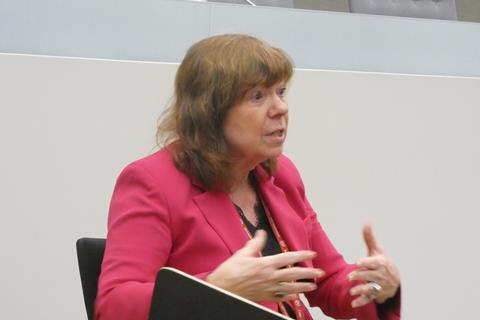
Speaking to the media late yesterday, Judge Prost described the wave of attacks and sanctions as ‘futile’, adding: ‘We continue to do our jobs, independently and objectively looking at facts and evidence, applying the law, and [making decisions]. I must communicate that message, because we will not be intimidated.
‘Compared to what I see in my cases, these [sanctions] are inconveniences and annoyances. But it’s being done in order to try and get us not to do our jobs, not to issue a decision, or to do so in a way the United States administration would like. That is a fundamental attack on the rule of law. I remain completely determined and it no way affects my mission. It’s too important. The victims are too important.’
Prost called for ‘strong measures’ by state parties to the Rome Statute which created the ICC in 2002. The UK and EU member states have been urged to turn to blocking statute powers that would enable them to curb US extra-territorial overreach. The blocking statute has been described as the ‘nuclear option’ by Chatham House.
‘The United Kingdom has a blocking statute akin to the blocking statute of the European Union as does Canada. I think everyone should be looking at the statute. It’s so important our states step up at this stage. There have to be clear red lines.’
Asked by the Gazette if she believes the UK in particular is doing enough to protect court staff, she responded: ‘That’s an interesting issue. Certainly, the UK has expressed its strong support. Where I’ve had troubles with the UK is that it is one of the places where over-compliance [with sanctions] has been the most evident.
'Sometimes I make transactions within the EU or even with Canada, and they’ll bounce the transaction. They’ll bounce whatever I’ve done and send it back to me. In the United Kingdom, I have two instances where money was blocked [by the UK branch of a US bank] and remains frozen.
‘This is the scenario, - money sent from here in the Netherlands in Euros to the United Kingdom in pounds. And I get an e-mail which says, "your money has been blocked on the basis of the order of the President of the United States". And if you want your money back, you must apply to the Office of Foreign Assets Control in the United States.
'I have told the UK authorities that I don’t understand why the sovereign state of the United Kingdom could do nothing about it.'




9 Readers' comments